Everything generated locally
Pictures, motion, voice, music, sound effects, captions and graphics come from open-weight models on your own hardware. There is no stock footage and no paid generation API.
The pipeline
Shotcoda is twelve scripted stages that pass files to each other. An LLM director makes the creative calls, open models generate every asset on your GPU, and deterministic code does the timing, editing, mastering and checks.
Pictures, motion, voice, music, sound effects, captions and graphics come from open-weight models on your own hardware. There is no stock footage and no paid generation API.
The voice is generated first. Every cut, caption and graphic is timed from the spoken words, so nothing drifts and every caption is exact.
Creative intent lives in two JSON files. Any stage can be re-run on its own, so an AI agent can operate the whole studio the same way a person would.
Scores candidate topics by search demand, trend and how comparable Shorts perform. The winner becomes a brief with a verified fact sheet, where every number has a source.
brief.md The director writes a hook-first narration and a shot list: image prompt, one camera move, overlay and sound cue per shot. Everything lands in one editable JSON plan.
plan.json A narrator is designed from a text description, so no real person is cloned. Each sentence is spoken in several takes and transcribed back, and the cleanest take wins. Word-level timings come out too.
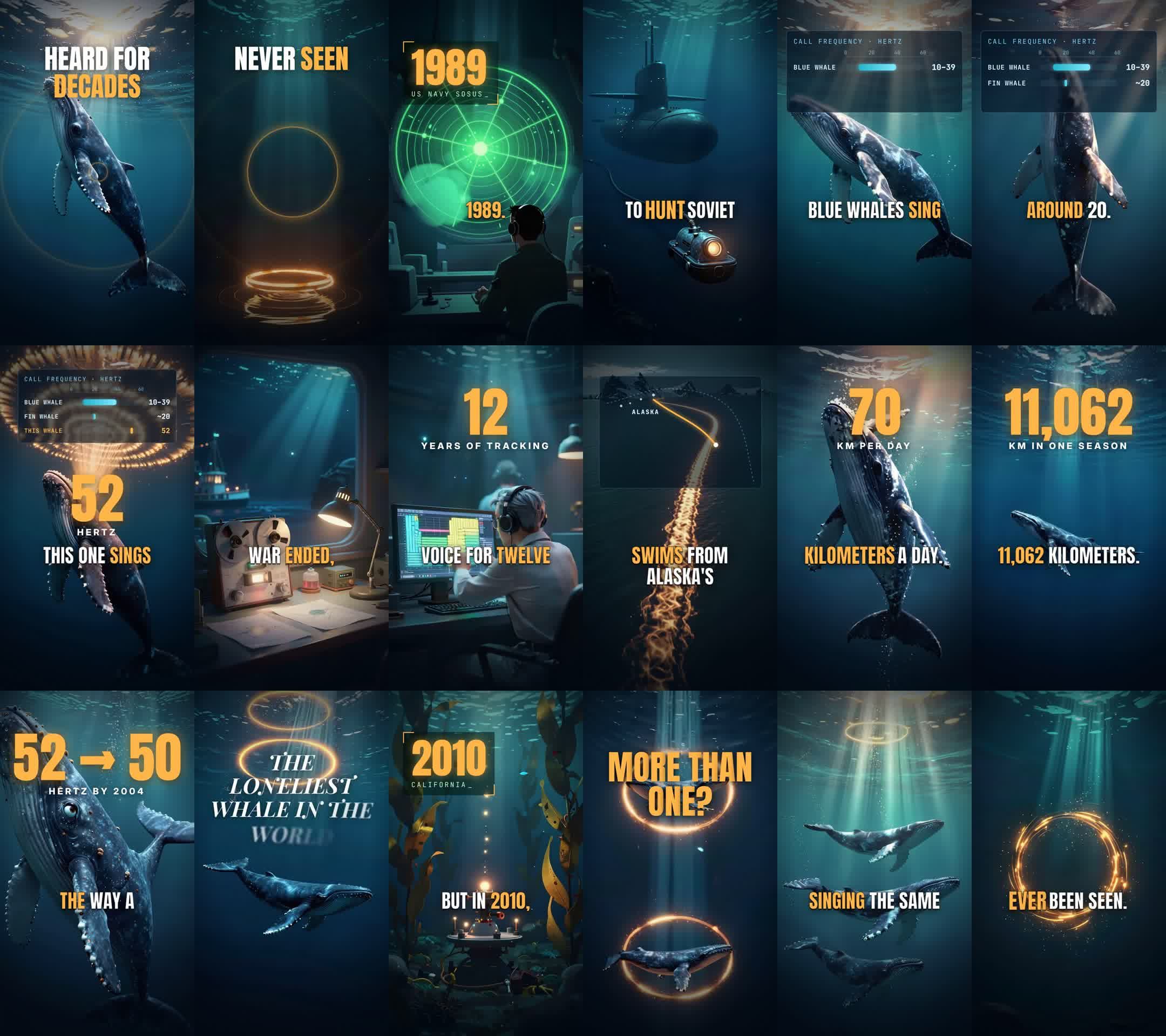
vo.wav · words.json Vertical 1088×1920 keyframes are painted in one consistent visual world. A contact sheet goes to the director, human or agent, who picks or regenerates frames before any motion is spent.
keyframes/ · picks.json An original instrumental score is generated to the narration length. It is made locally and registered in no Content ID pool.
music.flac The narration is the clock. Every cut lands 0.12 s before its first word, and captions are exact to the spoken word.
timeline.json Image-to-video with the high-noise expert on one card and the low-noise expert on the other. Only a small latent file crosses between them, so two 16 GB cards do what would otherwise need one very large one.
clips/*.mp4 The 16 fps clips become smooth 32 fps footage at the full 1080×1920 resolution.
clips_hd/*.mp4 The whole edit is generated as code: cut effects, film grain, animated captions where the spoken word turns amber, count-up numbers, charts, maps and exact shapes.
picture.mp4 Whooshes, impacts and risers are synthesised in code, so there are no sample licences. The music ducks under the voice, and the mix is mastered to −14 LUFS and −1 dBTP.
final.mp4 Seven deterministic checks: resolution, frame rate, duration, length, loudness, true peak and unplanned black frames. Then a local vision model scores one frame per shot and flags garbled text or wrong subjects.
qc/report.json Title, description, tags and AI disclosure are written from the fact sheet. The video uploads on a schedule, or waits for your OK. You decide.
live Short The creative plan
The director writes beats of narration, and each beat gets shots. Change a line, a prompt or an overlay and re-run just the stage it affects.
// saturn10/plan.json (excerpt, real episode)
{
  "title": "Saturn's Hexagon Has a New Twin",
  "voice_design": "Male documentary narrator in his forties.
     Deep, warm baritone… measured, suspenseful pacing",
  "music_prompt": "cinematic ambient space underscore…
     72 bpm, instrumental, no vocals",
  "beats": [{
    "vo": "Above its north pole, a six-sided jet stream never
           stops spinning. It's 30,000 kilometers across.",
    "shots": [{
      "id": "s03", "kind": "clip",
      "image_prompt": "a gas giant's polar vortex seen from
         above at an oblique angle, swirling golden clouds…",
      "motion_prompt": "the cloud bands rotate around the
         center, camera holds steady"
    }, {
      "id": "s04", "kind": "graphic", "bg_shot": "s03",
      "overlay": "big_number",
      "overlay_value": "30,000",
      "overlay_label": "KILOMETERS ACROSS",
      "sfx": "impact"
    }]
  }]
}
Quality control
A contact sheet of every shot, plus a three-tier gate: machine checks, a local vision-model judge, and a final review by a person or an agent.
1080×1920, 30 fps, duration within 0.25 s of the timeline, under 3 minutes, −14 ± 1 LUFS, true peak ≤ −1 dBTP, no unplanned black frames.
A local multimodal model scores one frame per shot against its prompt. It hard-fails garbled pseudo-text, deformed anatomy, overlapping or cut-off text, and pictures that contradict the story.
Facts on screen match the fact sheet, names are pronounced right, music never masks the voice, and the ending loops cleanly into the hook.
Details
It can run end to end without a person. Two checkpoints are built in, the shot plan and the keyframe picks, and an AI agent or a human can handle both. You can keep a final approval before publishing, or let it post on a schedule.
Any LLM that can write JSON. Shotcoda ships with a local Qwen3.8-27B served by llama.cpp, which also runs the vision quality check. For the strongest scripts you can plug in the Claude or ChatGPT account you already have. No other subscription is involved.
Keyframes keep every shot in one visual world, they are cheap to review, and they anchor the video model. A bad frame is caught in 26 seconds instead of wasting minutes of motion generation.
Not by the image model. Image models cannot count sides or spell reliably, so every number, chart, map and exact shape is drawn as a motion graphic in code (HTML + GSAP) on top of the generated picture.
One generated HTML file per episode, rendered frame by frame in headless Chrome by HyperFrames. Graphics cost only code, rendering is deterministic and a linter catches layout mistakes before the render.
Build my video pipeline
Tell me what you make and where you publish. I'll check your hardware, build the pipeline around your format and brand, and set it up on your machine. No pricing tables: every setup is different, so you get a straight answer.